What Is a Nonce Crypto? Full Guide to Blockchain Mining
You’ve probably heard of Bitcoin or blockchain a time or two, and come across the odd little term, nonce. It may sound counterintuitive, but it is a big contributor to the security of crypto networks. So then, what does a nonce crypto term mean and why is it so important?
In layman’s terms, a nonce is a number that is used once in a cryptographic transaction and is random or semi-random. In the crypto world this is the number that the miners rotate and rewrite to generate a valid block hash. It is essential for the proof-of-work mining process to work, or else blockchains will be much easier to attack.
In this guide, the concept of a nonce is explained in simple terms. You’ll find out what it is and why it’s crucial for security, its role in mining, and its importance in day-to-day blockchain transactions. No jargon overload – just explanations that are easy to use.
What is a Nonce Crypto? (The Simple Definition)
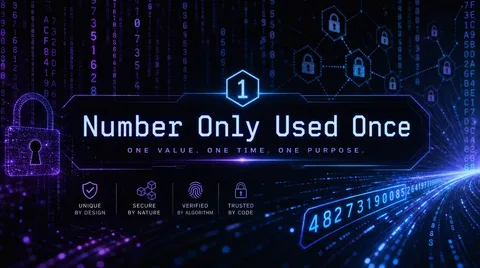
The term “nonce” is derived from the term “number used once. It is simply that, at its core, that is. A value (typically a number) that is created and used only once by a system.
Miners in cryptography use nonces to prevent the reuse of old data in an undesirable manner. The role of a nonce becomes more specific in the context of crypto and blockchain. They alter a figure when they attempt to solve the mathematical puzzle necessary for adding a new block to the chain.
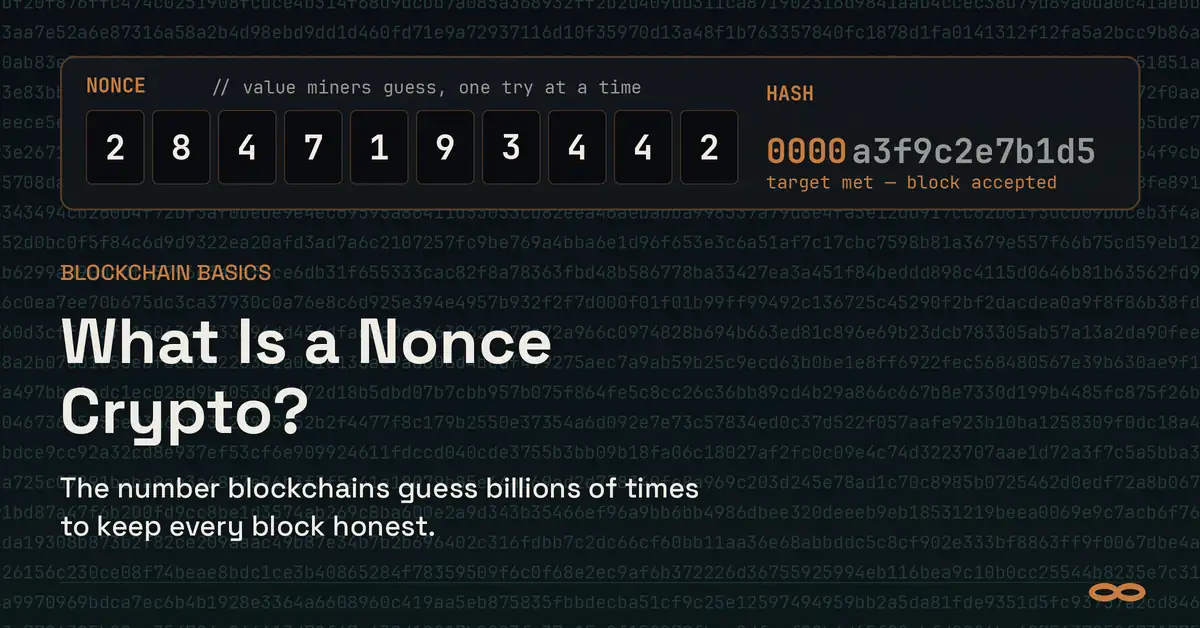
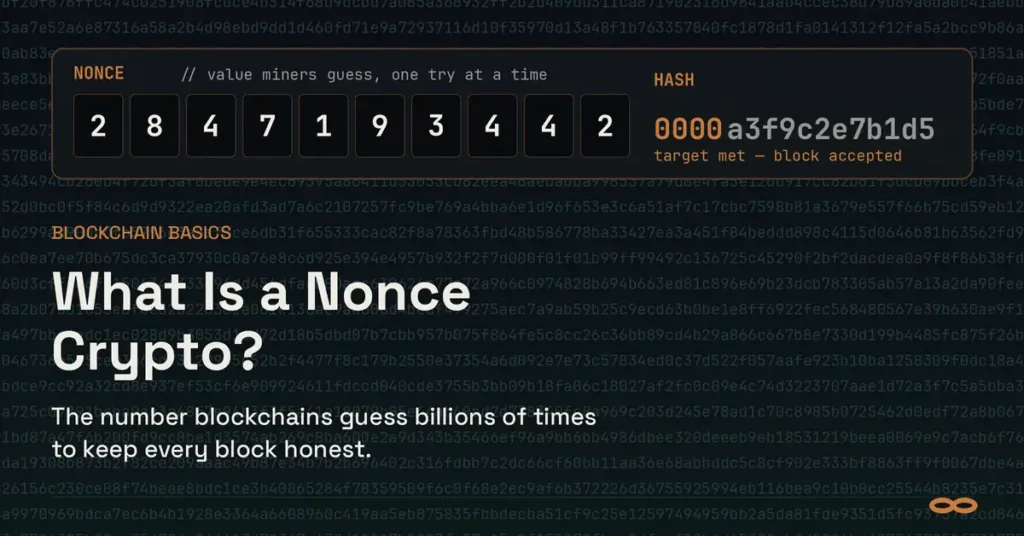
So, when they ask what a nonce crypto system relies on, the short answer is this – it’s the changing variable of each mining attempt. Miners have no idea of the correct nonce beforehand. They must guess and guess again until the hash conforms to the network’s difficulty level.
Imagine a combination lock box with billions of keys! The miners are not skilfully picking the lock. They are using trial and error, trying one combination after another, until they find the right one.
What is a “Nonce” in Blockchain Technology?
To grasp a nonce, you must first learn about hashing. A hash function converts any data, whether text, numbers, or transaction data, into a string of fixed-length characters. The output hash changes completely if one letter of the input changes.
This property is used to the benefit of blockchains. Every block has transaction data, a timestamp, the hash of the previous block, and a nonce. This is all applied through a hash function. The objective is to create a hash that begins with a set number of zeros, determined by the network difficulty.
The twist is that the miners cannot determine the hash of a particular input. The only way to locate a suitable hash is to try options and see what works. That’s where the nonce comes into play.
A nonce is a special field in proof-of-work mining.
In a proof-of-work system, such as Bitcoin, mining is actually a huge guessing game. Miners solve the problem by taking the data from the block and inputting a nonce value into the hash function. If the hash is not close to the target, they adjust the nonce and repeat the process.
This is repeated a trillion times each second throughout the network. Today’s mining rigs are designed to do this calculation as quickly as possible. The first miner to calculate a valid nonce will be able to add the new block and receive the block reward.
With a nonce field of 32 bits (as originally designed for Bitcoin), the 4.3 billion values in this field can be used up without finding a match. When they do, they modify other variables within the block – such as the extra nonce or the block’s timestamp – and begin to guess again.
Nonce, in Cryptographic Hash Functions.
Nonces also play a role in general cryptography outside of mining. They enhance encryption, digital signatures, and secure communications. The aim is to always ensure that any certain data set is not reused without the ability to be exploited.
For instance, some secure messaging applications encrypt messages and add a nonce. This prevents attackers from intercepting an old message, which remains legitimate, then resending it at a later time and using it to deceive the system; this is called a replay attack.
What is the significance of a nonce in Crypto Security?
A nonce isn’t just a technical detail. It plays a crucial role in the security and trustworthiness of blockchains. Why it’s so important.
Preventing Replay Attacks
A replay attack occurs when a valid transaction is captured and then replayed, trying to cause the system to process the same transaction twice. A nonce is just one-time use only, so reused data will be rejected in real time. This One-Use-Only rule bans an entire category of attacks.
Ensuring Blockchain Immutability
The reason why blockchain is valuable is due to the fact they cannot be easily rewritten. It’s a big part of the reason. If an attacker attempted to change any of the previous blocks, they would have to redo the proof of work calculation for that block and all subsequent blocks. This is almost impossible, bearing in mind the amount of power the network already has. Together with the hashing, the nonce makes it very costly and time-consuming to be tampered with.
Making Mining Fair and Random
The final thing – nobody can predict which nonce will create a valid hash, so that any miner has no advantage over the others through knowledge only. Success is not a matter of tricks, or of greater computational power, but of good fortune. It ensures that the mining process is decentralized and cannot be easily manipulated.
Nonce vs Hash: What is the difference?
Often, people can confuse these two terms, but they should not be.
A hash is the result, a fixed-length string that a hash function produces when it processes the data. A nonce is just one item in the input that someone alters to modify that output. In short:
- A nonce is a number that the miners can control.
- That variable is called the hash and produces the result of the block, along with the rest of the data.
Miners don’t look for a certain hash. They are looking for a nonce that, when combined with the other data in the block, produces a hash that is equal to the difficulty target.
Let’sLook at another example of its real-world application
Let’s explain a simplified version of the process of Bitcoin mining.
- A miner collects the pending transactions in a candidate block.
- The miner writes the previous hash, a starting value for the nonce (usually 0), and adds a timestamp.
- The entire block header is passed through the SHA-256 hashing algorithm.
- The miner determines if the new hash has sufficiently many leading zeros to comply with the current difficulty level.
- If it doesn’t, the miner increases the nonce by one and hashes again.
- This process is repeated — sometimes billions of times a second — until a valid hash is found.
- The miner who wins publishes the block to the network, and other nodes instantly verify it by checking the hash.
The final step is crucial. The nonce is very hard to find, but very easy to verify. This imbalance – which is hard to solve, easy to verify – is why proof-of-work is secure.
Common nonces that you should be familiar with.
If you dive deeper into blockchain and crypto, you will come across several other related terms besides “nonce. Let’s take a quick tour:
- Extra nonce: This is added by miners when the regular nonce range has been used up.
- How many hash calculations (or nonce guesses) a miner or network can perform in a second.
- Difficulty target: The number that a hash value needs to exceed; this is used to define the number of leading zeroes in a hash.
- Block header: The part of the block that holds the nonce, the timestamp, the previous hash, and other data.
- Proof of work: The entire system based on the algorithm of guessing the nonce.
Combining these terms helps to better comprehend the technicalities of how blockchains work under the hood.
Is the nonce used in the same manner across all blockchain applications?
Not exactly. The basic idea, a one-use number for verification, remains the same, with the implementation differing.
The nonce is a unique number exclusively for mining purposes on Bitcoin and other proof-of-work chains. Prior to transitioning to proof-of-stake, Ethereum also had a mining nonce. Regular accounts also have a different type of nonce in Ethereum: The transaction nonce, which keeps track of the number of transactions sent by the account. This ensures that no transactions are processed twice and maintains the order of transactions.
Blockchains that do not need mining, such as Proof-of-Stake systems, use nonces more for transaction processing and cryptographic protection. In blockchains without mining, like Proof-of-Stake, systems use nonces more for transaction processing and cryptographic security. Even though the concept of a nonce is the same across all networks, how it works in the network’s consensus protocol can vary.
Frequently Asked Questions.
If you’re looking to invest in cryptocurrencies, what is a nonce?
In cryptography, miners usually tweak a nonce, a number that is used only once, in the process of mining a proof-of-work version of the desired hash to satisfy the network’s difficulty target.
Why do miners need a nonce?
Miners require a nonce because it’s the only thing they can modify freely to generate different hash outputs. They would not be able to search for a hash that meets the difficulty if they didn’t change the nonce.
Are private keys equal to nonce?
No. A nonce is not for the same purpose as a private key. The private key is what secures ownership of crypto assets, and the nonce is not used for the purpose of ownership.
May there be more than one nonce?
No, by definition a nonce should never be reused for the same purpose. The use of reusability of a nonce can compromise security and, in certain systems, allow replay attacks and/or duplicate transactions.
What’s the difference between a nonce in Bitcoin and Ethereum? A nonce is primarily a Bitcoin mining tool that helps miners discover valid block hashes. In Ethereum, miners work with a nonce related to mining as well, but there is also a transaction nonce that records the number of transactions that a wallet address has made, enabling the prevention of duplicate transactions.
Final Thoughts: The Value of Knowing a Nonce
Now, it should be easier to understand what the answer to “what is a nonce crypto systems depend on” is. There is a small number with a big responsibility: to defend blockchain networks, to ensure fair mining, and to prevent common attacks, such as replay attacks.
If you’re new to blockchain or just revisiting it before a more in-depth technical dive, knowing what the nonce is provides you with a solid foundation. It’s a concept that,t when you get it, the rest of blockchain technology becomes much easier to follow.
For those interested in the details, you can read about the rest of the components of proof of work and hashing. Continue reading, doing research, and asking questions: “What is one of these on the nonces?” and you will soon understand blockchain in a much more profound way.